


Sustainability
Sustainable Factory Flooring
Food manufacturers are under increasing pressure to meet sustainability targets while maintaining the highest standards of hygiene, safety, and productivity.
At Kemtile we help food manufacturers achieve these goals through high-performance flooring, wall, and ceiling systems engineered for demanding food production environments with sustainability built in


A pioneering vertical farming facility, which is helping to reshape the future of sustainable food production, has partnered with Kemtile to deliver a durable and hygienic flooring solution for its innovative fresh food production environment. Designed around a bio-secure, closed-loop growing system, the facility aims to reduce water consumption, eliminate chemical run-off and minimise soil degradation, creating a more sustainable approach to food production. To support the customer’s long-term sustainability objectives, the flooring solution needed to maximise service life, minimise future maintenance and reduce the likelihood of premature replacement.
Crack Bridging Membrane
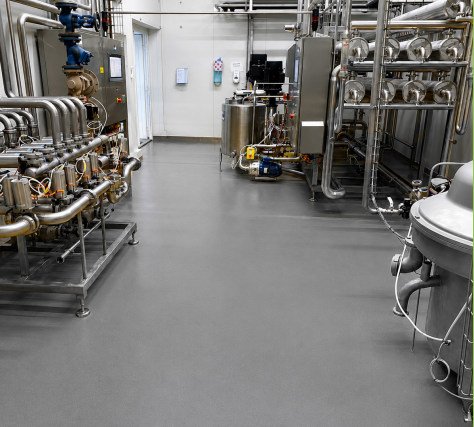
The weak concrete surface layer was mechanically removed before the installation of Stonproof RH7, a flexible, fibre-reinforced crack bridging membrane. The system was selected to accommodate potential future substrate movement while protecting the integrity of the finished floor. The membrane was then overlaid with Stonclad GS, Stonhard’s heavy-duty power-trowelled epoxy screed system, finished with a Texture Two profile to provide enhanced slip resistance and safe pedestrian access.
Slip Resistant flooring
The completed flooring installation delivered a hard-wearing, slip-resistant and hygienic surface capable of performing in a demanding high humidity environment.
Sustainability Benefits
Extending Asset Life
The flooring system helps prevent reflective cracking and premature failure. This significantly extends the service life of the floor.
Reducing Material Waste
A durable flooring solution means fewer repair and refurbishment cycles over the life of the facility, minimising waste generation and lowering overall environmental impact.
Supporting Efficient Cleaning Regimes
The seamless, non-porous floor finish is easy to clean and maintain. Efficient cleaning processes can help reduce water and chemical use while supporting high food safety standards.
Future-Proofing Sustainable Food Production
As vertical farming facilities continue to expand across the UK, durable building infrastructure plays a critical role in supporting operational efficiency and sustainability. The flooring system was designed to withstand
the challenging environmental conditions while helping the facility maintain uninterrupted production.
Recycled Material Innovation from Kerbing Experts


Polysto, one of the leading suppliers of hygienic kerbs and wall solutions to the food and beverage industry, and a valued partner to Kemtile, has launched new kerbing technology to help customers meet sustainable goals.
CleanRock® kerbs from Polysto are a next-generation composite made from high-performance polyester resins, quartz granules and carefully selected additives plus recycled cut-off materials from the company’s CleanSheet panels for walls and ceilings. The new CleanRock® kerbs build on an earlier R&D project exploring recycled composite materials, including recyclates from wind turbine blades. Today, PolySto uses recycled content from its own FRP production process, making the new kerbs stronger and more sustainable.
Beyond its new circular material formula, CleanRock® also introduced a new patented foot geometry. The so called ‘CleanWave’ has been designed to improve cleaning efficiency. Traditional coved skirtings often create uncontrolled splash-back of cleaning water onto walls during high-pressure washdowns.
The unique geometry of the CleanWave design helps guide water in a more controlled manner towards drainage systems, reducing unnecessary water dispersion. This contributes to more effective cleaning while potentially lowering water and chemical consumption. The new foot geometry shields the floor coving from mechanical impact, guarding vulnerable edges and delivering long-lasting, robust protection.
CleanRock® kerbs are engineered for exceptional impact resistance, watertight performance and protection against bacterial contamination. Kerb design is a critical factor in food safety, preventing hidden contamination at the wall-floor transition. Kerbs face constant exposure to water, impact and aggressive cleaning. When they crack, absorb moisture or degrade, they become hidden contamination points — hygiene risks that often remain unnoticed until serious problems arise.
Pathogens such as Listeria and Salmonella thrive in areas behind damaged kerbs, in open joints and in micro-cracks. High-pressure cleaning does not solve the problem. It often spreads contamination across the production area. Because kerb failures are rarely visible, issues are detected too late. The result: failed audits, production stops or product recalls.
CleanRock® is PolySto’s engineered core material for hygienic kerbs, developed to deliver long-term wall protection in demanding food-processing environments. Now available in a new formula using recycled materials for the first time.
EXPERT INTERVIEW
A Sustainable Approach That Stands Up to Demands of Food Production
We chatted with Dave about the key considerations:
“Food manufacturers are under increasing pressure to meet sustainability targets while maintaining the highest standards of hygiene, safety, and productivity.
At Kemtile we help food manufacturers achieve these goals through high-performance flooring, wall, and ceiling systems engineered for demanding food production environments with sustainability built in.
There is a hidden environmental cost of flooring refurbishment that not many realise which means you want to minimise the time you spend replacing flooring.
At Kemtile we are committed to doing it once and doing it well. Longevity and durability is at the heart of everything we do.
If you think about it every floor replacement, wall repair, or facility shutdown generates:
• Construction waste sent to landfill
• Additional raw material consumption
• Increased carbon emissions from manufacturing and transportation
• Production downtime and lost efficiency
• Additional labour and maintenance costs
The most sustainable solution is one that performs reliably for years, reducing the need for replacement and ongoing repairs. Our systems are built for the long-term designed to withstand:
✓ Heavy forklift traffic
✓ Aggressive cleaning chemicals
✓ High-pressure washdown regimes
✓ Thermal shock from hot water and steam cleaning
✓ Impact damage from production operations
✓ Wet processing environments.
By extending service life and reducing maintenance requirements, Kemtile solutions support a lower total environmental footprint throughout the lifecycle of your facility.
From intake and processing areas to packing halls, cold stores, warehouses and staff welfare facilities, our hygienic systems are designed to perform in every part of the food manufacturing process.
We work with food manufacturers to support ESG and net zero objectives. So we help:
• Reduce facility lifecycle costs
• Minimise construction and refurbishment waste • Improve operational efficiency
• Extend asset longevity • Enhance workplace safety
• Support Environmental, Social and Governance (ESG) targets
Dave added: “Sustainability is not only about reducing energy consumption. It is about creating facilities that last longer, perform better, generate less waste, and support efficient food production for years to come.”

Dave Sleight from Kemtile has over 40 years’ experience in the food and beverage industry and advises food factories on approaches to installing flooring to meet sustainability goals.


Redefining Sustainable Flooring for CIP Environments
Clean-in-Place (CIP) areas present some of the most demanding conditions within food and beverage manufacturing.
Frequent exposure to aggressive chemicals, elevated temperatures, thermal cycling, and intensive cleaning regimes can significantly reduce the lifespan of conventional flooring systems, leading to repeated repairs, increased material consumption, unplanned downtime, and higher lifecycle costs.
To address these challenges, Stonhard has developed Stonchem CIP, an advanced flooring system that combines the proven thermal shock resistance and durability of Stonclad UT with the exceptional chemical resistance of Stonchem 800 Series vinyl ester technology.
By delivering extended service life, reducing maintenance requirements, and minimising the need for premature floor replacement, Stonchem CIP supports a more sustainable approach to facility management.

Kemtile is a division of Stonhard, which is part of RPM International Inc. Based in the US, RPM is a $7.4 billion multinational company founded in 1947, with subsidiaries that are world leaders in specialty coatings, sealants, building materials and related services.
RPM has a significant commitment to a sustainable future describing its philosophy as one that reflects its values of Transparency, Trust and Respect. Its Building a Better World vision commits to sustainability in multiple forms – its products, its people and its processes, all of which is built on a foundation of strong governance.
With operations worldwide, it takes a localised approach to creating meaningful impact in the communities where it lives and works. RPM believes long-term success comes from doing the right things, the right way, for the right reasons.
Its Building a Better World programme integrates sustainability into every level of its business. It equips associates at Kemtile and across the world with an understanding how sustainability issues – like climate change – may impact risks, opportunities and strategies, and encourages them to lead, innovate and help achieve both its own and its customers’ sustainability goals.
To read RPM’s latest sustainability report go to: https://www.rpminc.com/media/5t4bkhcj/rpm-2025-sustainability-summary.pdf
