


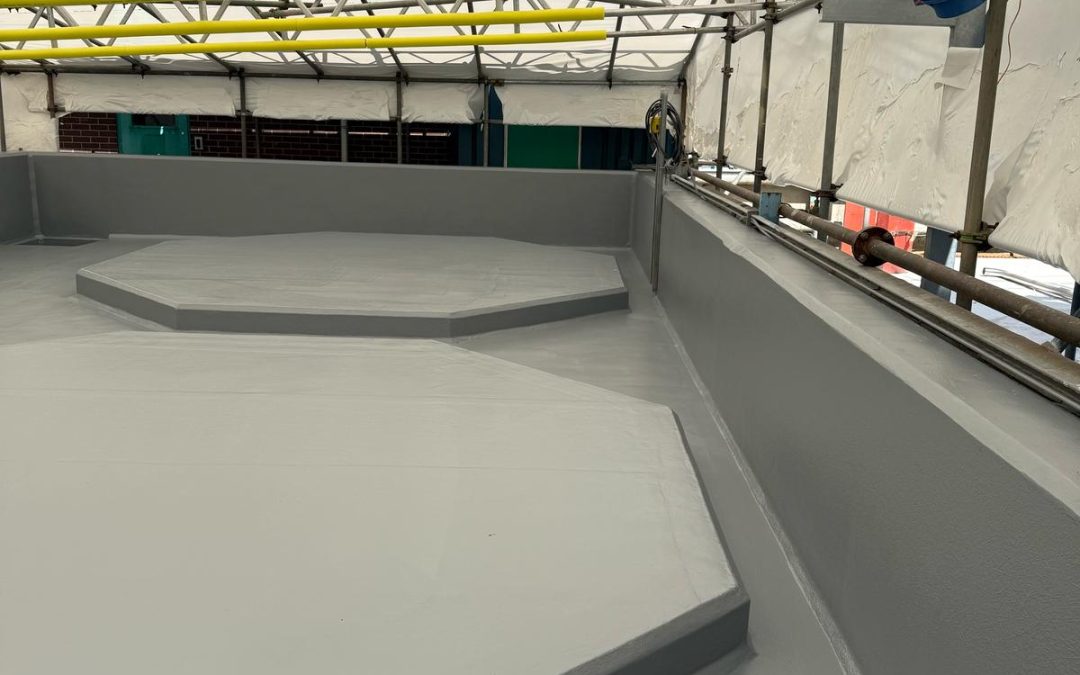
A chemical bund is designed to be the last line of defence. If a storage tank leaks, a pipe fails or a vessel releases its contents, the bund must contain that material and prevent it from spreading into surrounding production areas, drainage systems, soil or groundwater. But there is another important consideration. Experienced flooring expert Dave Sleight says the bund itself also needs protecting. Here he answers 15 key questions about protecting the structure from the concrete up.
1.Why do people consider concrete chemically-resistant? It's not!
Many secondary containment structures are constructed from reinforced concrete. While concrete provides excellent structural strength, it should not automatically be considered chemically resistant. Exposure to aggressive acids, alkalis, solvents and other process chemicals can attack the concrete, penetrate the surface and, in severe cases, eventually reach the steel reinforcement within the structure. Once that happens, what started as a surface protection issue can become a structural problem. At Kemtile, this is why we look at chemical bund linings as much more than simply applying a resin coating. The solution needs to protect the containment integrity, concrete substrate and potentially the reinforced structure beneath it.
2. Why do reinforced concrete bunds need protection?
Reinforced concrete is widely used for bund construction because it is strong, durable and capable of forming substantial containment structures. However, concrete is naturally porous. Without suitable protection, liquids can potentially penetrate into the concrete through the surface, cracks, construction joints, poorly detailed penetrations or areas where the substrate has already deteriorated. The severity of the attack depends on several factors, including:
* Chemical type
* Concentration
* Temperature
* Duration of exposure
* Frequency of spills
* Condition and permeability of the concrete
* Existing cracks or defects
* Quality of previous coatings or linings
Certain aggressive chemicals can progressively break down the cementitious matrix of the concrete. The visible signs may begin with relatively minor surface deterioration, such as discolouration, softening, pitting or erosion. But the damage may not stop at the surface.
3. What happens when chemical attack reaches the reinforcement?
This is where deterioration of a reinforced concrete bund can become significantly more serious. Steel reinforcement is normally protected by the surrounding alkaline concrete environment.
If aggressive substances penetrate sufficiently deeply, or if cracking and deterioration compromise the concrete cover, the reinforcement can become vulnerable to corrosion. Corroding steel can expand, placing pressure on the surrounding concrete.
The result can include: cracking → delamination → spalling → exposed reinforcement → further corrosion → loss of structural integrity.
At that stage, simply applying another coating over the surface is unlikely to address the underlying problem.
Damaged concrete may need to be removed, reinforcement assessed and treated where required, and the concrete reinstated using appropriate repair materials before the chemical-resistant lining system can be installed. This is one of the reasons early inspection and maintenance of bunds is so important.
Protecting the concrete today can help prevent a much more complicated structural repair tomorrow.
4. Why should the substrate always come first?
Every successful chemical-resistant lining starts with the substrate. Before recommending a system, we can assess the condition of the existing bund and identify factors that could affect the performance of the proposed lining.
This can include assessment of:
* Existing coatings and their adhesion
* Concrete strength and condition
* Surface contamination
* Moisture
* Cracking
* Spalled or deteriorated concrete
* Construction and movement joints
* Wall-to-floor junctions
* Drainage interfaces
* Pipe and service penetrations
* Existing repairs
* Signs of previous chemical attack
Where necessary, further testing can be undertaken to develop a clearer understanding of the substrate condition. The objective is simple: We need to understand what we’re putting the new system onto before deciding what should go on top of it.
5. Why should preparation be part of the system?
The chemical-resistant lining is only as reliable as the substrate supporting it. Depending on the condition of the bund, preparation may involve mechanical methods such as shot blasting, grinding or other appropriate techniques to remove contamination, weak material and previous coatings. Cracks, voids and damaged concrete may also require repair.
If reinforcement has become exposed due to concrete deterioration, the problem needs to be assessed rather than simply covered over.
The substrate must be capable of supporting the new lining. Putting a high-performance chemical-resistant system over weak or deteriorating concrete does not make the concrete underneath structurally sound.
6. Why should the chemical determine the specification?
One of the biggest mistakes in chemical containment is treating the words “chemical resistant” as though they describe one universal level of performance. They don’t.
Different resin technologies have different resistance profiles. A system capable of handling one acid at a low concentration may not be suitable for that same chemical at a significantly higher concentration or temperature.
Similarly, solvents, strong alkalis, oxidising agents and mixtures of chemicals can present completely different challenges. Before specifying a bund lining, we need to understand:
- What is being stored?
- At what concentration?
- At what temperature?
- How long could the lining potentially be exposed following a major release?
- Could several chemicals become mixed within the bund?
- How will the area be cleaned following a spill?
The answers influence the selection of the lining system.
7.What is the difference with Stonchem Chemical-Resistant Systems?
As a division of international manufacturing and install experts Stonhard, Kemtile can provide access to specialist Stonchem chemical-resistant flooring and lining technologies for demanding industrial environments.
Depending on the chemical exposure and operating conditions, systems within the Stonchem 600–800 range can provide solutions for secondary containment areas, chemical processing environments and tank farms.
However, the product should never be selected simply because it is described as chemical resistant.
The chemical exposure needs to be checked against the appropriate resistance information and technical guidance before the final specification is confirmed.
The chemical comes first. The product comes second.
8. Why do reinforced bunds need complete protection?
With reinforced concrete containment structures, protecting only the horizontal floor isn’t enough. The bund needs to be considered as a complete structure.
Chemical exposure could occur across:
* Bund floors
* Internal walls
* Upstands
* Equipment plinths
* Tank bases
* Sumps
* Drainage interfaces
* Pipe penetrations
* Construction joints
* Movement joints
If the floor is highly chemically resistant but the wall junction or pipe penetration isn’t adequately protected, the containment system still has a potential weakness. This is why detailing matters.
9.Why are floor-to-wall junctions so important?
The internal angle where a floor meets a bund wall is particularly important. Rather than trying to force a lining into a sharp 90-degree junction, an appropriate cove or radius can be formed. This helps create a continuous transition between the horizontal and vertical surfaces and makes the lining easier to install consistently. It can also improve cleaning and inspection. The aim is to create a continuous protective envelope rather than treating the floor and walls as separate elements.
10. Why should cracks and movement joints never simply be painted over?
Concrete moves. Temperature changes, shrinkage, loading and structural movement can all create stresses within a reinforced concrete bund. Existing cracks therefore need to be assessed before lining. The same applies to movement joints.
A rigid chemical-resistant coating installed straight across an active movement joint may crack when the structure moves. Movement joints need to be recognised within the design and detailed appropriately using compatible systems. Ignoring the joint doesn’t stop the concrete moving.
11. Why are penetrations potential weak points?
Pipework and services frequently pass through bund walls and floors. Every penetration potentially interrupts the containment envelope. If the lining isn’t properly terminated and sealed around the penetration, chemicals can potentially find their way behind the protective system and into the concrete.
Once contamination travels beneath a coating, the visible surface may still appear relatively sound while deterioration is taking place underneath. That is why penetrations, terminations and interfaces deserve the same level of attention as the main floor area.
12. Why do you need drainage within a bund?
Drainage arrangements within chemical containment areas also need careful consideration. Any drain, sump or outlet passing through the containment structure must be properly integrated into the overall system. Otherwise, you’ve effectively created a weak point in the very structure designed to contain a release.
The drainage material itself must also be suitable for the chemicals it may encounter.
13. Why should you be wary of existing concrete damage?
One of the biggest risks when refurbishing an older chemical bund is assuming that because the concrete is still standing, it is still in good condition. Previous chemical exposure may already have caused deterioration.
Look beneath a failed coating and it is possible to discover:
* Soft or friable concrete
* Chemical contamination
* Surface erosion
* Cracking
* Delamination
* Spalling
* Exposed reinforcement
* Corroded reinforcement
* Previous repairs that are no longer sound
Installing a new lining without addressing these conditions risks trapping the problem underneath. A chemical-resistant coating protects concrete. It doesn’t repair structural deterioration simply by covering it. Where significant concrete or reinforcement damage is identified, appropriate structural assessment may be required before the lining works proceed.
14. Why should you commit to inspection and testing?
Once a chemical bund lining has been installed, the work shouldn’t necessarily finish with a visual inspection. Depending on the system and the level of risk, additional testing may be appropriate. For higher-risk containment applications, holiday or spark testing can be considered where technically suitable to help identify discontinuities, pinholes or defects within the protective lining.
The finished installation should also be incorporated into an ongoing inspection and maintenance programme.
Areas to monitor include joints, penetrations, impact damage, cracks, blisters, delamination and any evidence of chemical attack.
Small defects identified early are generally much easier to address than widespread deterioration discovered several years later.
15. What happens if a bund lining fails?
The potential consequences go beyond replacing a damaged floor. A serious failure could lead to:
- Loss of containment.
- Chemical attack of the concrete structure.
- Corrosion of reinforcement.
- Environmental contamination.
- Damage to surrounding equipment or infrastructure.
- Production disruption.
- Complex and expensive remediation.
- And potentially regulatory consequences depending on the materials involved and the nature of the release.
This is why secondary containment should be treated as an engineered protection system rather than simply another resin flooring project.
Our Approach at Kemtile
After decades of installing specialist industrial flooring systems, one principle remains consistent: good performance starts with understanding the environment before choosing the product.
For chemical bunds and secondary containment, our approach is based around:
Survey → Assess → Prepare → Repair → Specify → Detail → Install → Inspect
That means understanding the existing structure, the chemicals involved and the operating conditions before developing the solution. Sometimes that also means telling a customer that more substrate repair is required than originally anticipated. It’s a conversation worth having.
Are you planning a new bund or refurbishing an existing one?
If you’re responsible for a chemical processing facility, tank farm, manufacturing plant, food or beverage facility, utility site or other operation using secondary containment, Kemtile can support you from the initial survey onwards. Whether you’re dealing with a new reinforced concrete bund or an existing containment area showing signs of deterioration, getting the specification right starts with understanding what’s underneath the existing surface.
The lining is your concrete’s protection. The bund is your site’s protection.
Both need to work when they’re needed most.
Contact us at info@kemtile.co.uk to learn more or book a site visit.
